


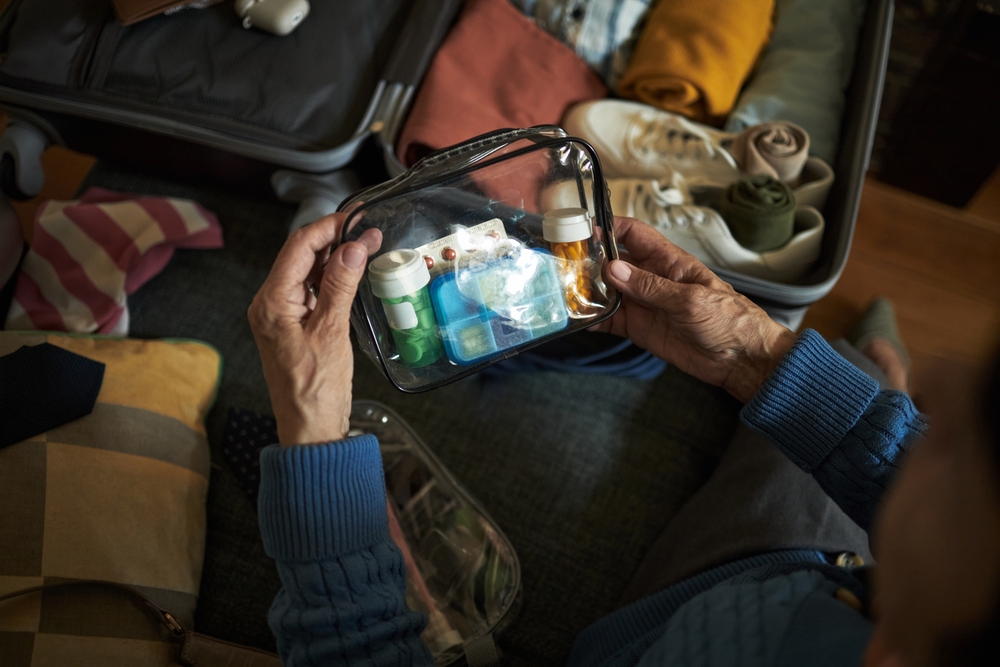
Can you travel internationally with prescription medications?
Usually yes — but preparation matters. Keep prescription medications in your carry-on and original labeled containers, and check destination-country rules before flying with controlled substances like ADHD medications, opioids, or benzodiazepines.
- →Always pack medications in your carry-on Lost checked luggage can quickly become a medical problem.
- →Bring original prescription bottles Customs officers may question loose pills in organizers or unlabeled containers.
- →Research medication restrictions before departure Some drugs legal in the US are restricted or banned abroad.
International travel with prescriptions is usually fine, but the few situations where it isn’t can be genuinely serious. People have been detained, fined, or had medications confiscated because they brought something perfectly legal in the US that’s tightly controlled or banned at their destination. A bit of preparation prevents almost all of it.
Pack medications in your carry-on, not checked luggage
This is the single most important rule. Checked bags get lost or delayed often enough that putting essential medication in one is a real risk — especially for medications you can’t skip safely (insulin, anti-seizure medications, transplant medications, blood thinners). Carry-on means the medication stays with you through delays, missed connections, and lost-bag scenarios.
TSA allows medically necessary liquids in excess of the 3.4 oz limit, so liquid medications, insulin, and similar items aren’t a problem at security — just declare them and remove them from your bag for separate screening. Domestic TSA doesn’t require pills to be in original prescription bottles, but international travel is different (more on that below).
Keep medications in original labeled containers
Your daily pill organizer is great at home and a problem at customs. Officers can’t identify loose pills, and “I think these are for blood pressure” doesn’t carry weight at the border. Bring the original prescription bottles. The label has your name, the prescriber’s name, the medication name, and the dosage — exactly what a customs officer needs to confirm legitimacy.
If you use a pill organizer day-to-day, the workaround is simple: bring the original bottles in your carry-on AND your organizer. Refill the organizer from the bottles after you arrive.
Bring your prescriptions and a doctor’s letter
Three pieces of paper that solve most problems before they start:
- Copies of all written prescriptions — with both brand and generic names. Helps if you need a refill abroad and confirms legitimacy at customs.
- A doctor’s letter summarizing your conditions and medications, written on letterhead. Particularly valuable for controlled substances, injectable medications (insulin, EpiPens, biologics), and anything with needles or syringes.
- A list of your medications with dosages, including over-the-counter ones. Useful for replacing anything that gets lost.
For non-English-speaking destinations, having a translated copy of the doctor’s letter helps if you need medical care or get questioned at customs. Many travel clinics will provide one if you ask in advance.
The countries where it gets complicated
A medication that’s perfectly legal in the US can be tightly controlled or completely illegal at your destination. Some examples that have actually caused trouble for travelers:
- ADHD stimulants (Adderall, Ritalin, Vyvanse, Concerta) — banned in Japan and several other countries. You can be arrested in Japan for bringing them in even with a valid US prescription.
- Strong painkillers (oxycodone, hydrocodone, codeine combinations) — restricted or banned in many countries. UAE, Singapore, Saudi Arabia, and Indonesia have particularly strict rules.
- Benzodiazepines (Xanax, Valium, Ativan, Klonopin) — controlled or banned in countries including Singapore, the UAE, and parts of the Middle East.
- Pseudoephedrine (Sudafed) — banned in Japan and a few others.
- Some asthma inhalers — surprisingly, certain combinations are restricted in some destinations.
- CBD and cannabis products — illegal in most countries regardless of US legality. Even hemp-derived CBD oils are restricted in many places. Don’t pack them.
Before any international trip, check the destination country’s rules. The International Narcotics Control Board has a country-by-country guide. The destination’s embassy website is another good source. The 30 minutes spent on this can save a very stressful situation at customs.
Which option fits your situation?
Basic travel preparation may be enough
- ✓You take common non-controlled prescription medications
- ✓Your trip is short and within countries with straightforward customs rules
- ✓You have medications in original labeled containers
- ✓You are bringing a few extra days of medication supply
- ✓You do not need refrigeration or injectable supplies
You should plan more carefully before traveling
- ✓You take ADHD stimulants, opioids, or benzodiazepines
- ✓You need insulin, biologics, or refrigerated medications
- ✓You are crossing multiple time zones with tightly timed medications
- ✓You are visiting countries with strict medication import rules
- ✓You may need a doctor’s letter or translated prescription documents
Time zones and dosing schedules
Crossing time zones disrupts dosing schedules for medications you take at specific times. Most medications are forgiving — a few hours’ shift over a few days is fine. The exceptions are worth thinking through with your doctor or pharmacist before you go:
- Insulin and diabetes medications — the math gets complicated when you cross multiple time zones plus add airline meals on a different schedule than home. Diabetes specialists can give you a specific plan.
- Birth control pills — take at the same actual time, not the same local time. A small alarm helps. Some hormonal contraceptives are more forgiving than others.
- Anti-seizure medications, transplant medications, anti-rejection drugs — the steady blood levels matter, and a 12-hour shift can be problematic. Plan with the prescriber.
- Blood thinners with timed dosing — worth a check with your prescriber for trips longer than a few days.
Bring more than you need
Pack at least a few extra days’ worth of every medication beyond the length of your trip. Travel delays are normal. Lost luggage happens. Getting an emergency refill abroad is sometimes complicated and sometimes impossible. Bringing 110% of what you need turns a missed-flight scenario into an inconvenience instead of a medical problem.
For longer trips, ask your prescriber for a 90-day supply or vacation override well before departure. Most insurance plans accommodate this for travel; the pharmacist can help with the paperwork.
Storage during travel
- Don’t check medications. Cargo holds get extremely cold, which damages insulin and many biologic medications.
- Insulin and refrigerated medications need an insulated travel pouch with cold packs for hot climates and long flights. The TSA permits cold packs for medical use.
- Avoid car dashboards and direct sun. Interior car temperatures can exceed 130°F (54°C) and damage most medications quickly.
- Hotel rooms in tropical destinations can run warmer and more humid than ideal. The hotel safe is often a cooler, drier spot than the bathroom counter.
What to do if something goes wrong
- Lost or stolen medications — contact your doctor or pharmacy at home for an emergency prescription that can sometimes be transmitted to a local pharmacy. Travel insurance often covers this.
- Need to refill abroad — the original labeled bottle helps the pharmacist match your medication to a local equivalent. Generic names are universal; brand names sometimes aren’t.
- Customs flagged your medication — the doctor’s letter is your friend here. If something is genuinely banned, customs may confiscate it; serious legal consequences are rare with a US-citizen tourist who has documentation, but possible.
- Severe allergic reaction or medical emergency — your travel insurance card and the contact info for emergency services in your destination country are worth keeping accessible.
For the broader picture on managing your medications safely day-to-day, the article on medication safety across all ages covers organizing your list, watching for interactions, and storing things properly — all of which apply at home and on the road.
Refill prescriptions easily before your next international trip
EasyRx connects you directly with local pharmacies for transparent cash prices on prescriptions and OTC medications — with same-day delivery. No insurance needed, no hidden fees, HIPAA compliant.
References
- https://www.cdc.gov/yellow-book/hcp/travelers-with-additional-considerations/traveling-with-prohibited-or-restricted-medications.html
- https://wwwnc.cdc.gov/travel/page/travel-abroad-with-medicine
- https://www.tsa.gov/travel/frequently-asked-questions/i-am-traveling-medication-are-there-any-requirements-i-should-be
- https://www.fda.gov/industry/import-basics/personal-importation