


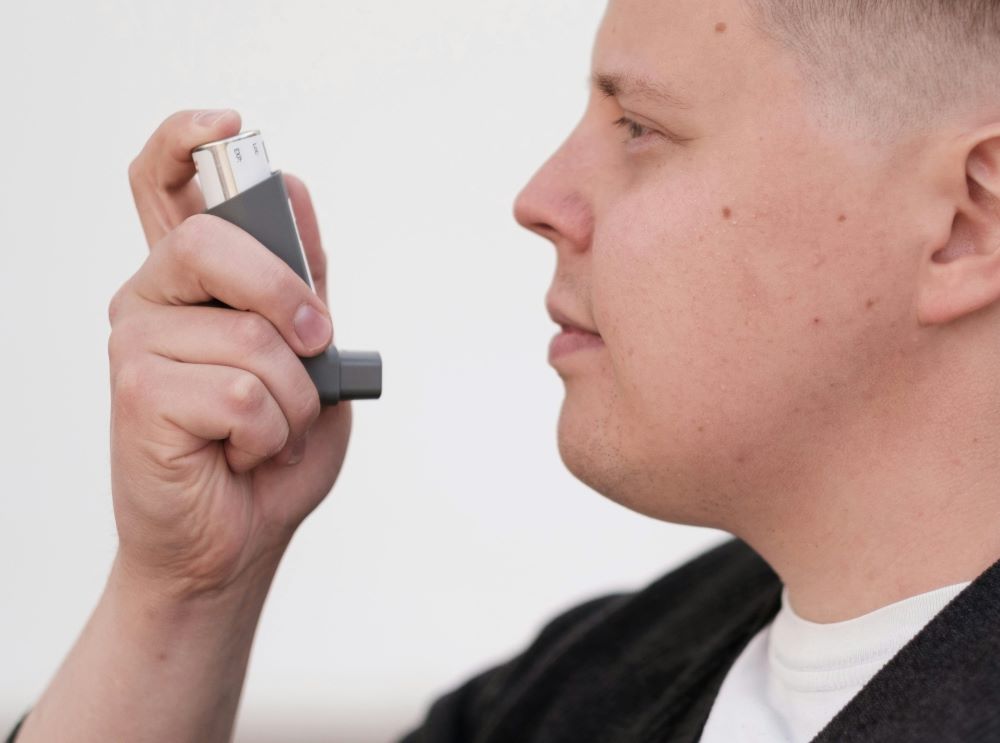
How do you actually use an inhaler correctly?
For a standard metered-dose inhaler, breathe out fully, press the inhaler as you start a slow deep breath in, then hold your breath for about 10 seconds. The most common mistakes are breathing in too fast and skipping the breath-hold afterward.
- →A spacer helps medication reach your lungs It reduces medication loss in the mouth and throat.
- →Different inhalers use different techniques Dry powder inhalers require a fast deep breath instead of a slow one.
- →Rinse after steroid inhalers This helps prevent oral thrush and hoarseness.
If you’ve been using an inhaler for years and your asthma or COPD still flares up too often, the medication may be fine — your technique might just be losing most of it in the back of your throat. Studies have shown that without a spacer, only about 9% of the medication actually reaches the lungs. The other 81% lands in your mouth and throat, gets swallowed, and does nothing. With a spacer, that delivery roughly doubles. With proper technique on top, it gets better still.
Here’s how to actually do it.
Standard metered-dose inhaler (Albuterol, ProAir, Ventolin, Flovent, Advair, etc.)
- Take off the cap and check the mouthpiece is clean and clear.
- Shake the inhaler hard for 5 to 10 seconds. Every time. The propellant and the medication separate between uses, and unshaken inhalers deliver inconsistent doses.
- If it’s a new inhaler or you haven’t used it in a while, prime it by spraying a couple of test puffs into the air. Check the package insert for how many.
- Stand or sit up straight. Tilt your head back slightly. Breathe out fully — push as much air out of your lungs as you can.
- Put the mouthpiece between your teeth and close your lips around it. Keep your tongue out of the way.
- Start breathing in slowly through your mouth, and at the same moment press the canister down once. The timing is the part most people get wrong — coordinate the press with the start of the breath, not before.
- Keep breathing in slowly and deeply for 4 to 5 seconds. Slow is the key word. A fast gasp sends the medication into the back of your throat instead of down into your airways.
- Hold your breath for 10 seconds, or as close as you can manage. This gives the medication time to settle into your airway lining.
- Breathe out slowly through pursed lips.
- If you need a second puff, wait 30 to 60 seconds, shake the inhaler again, and repeat the whole process from step 4.
- Rinse your mouth with water and spit it out if you used a corticosteroid inhaler (like Flovent, Pulmicort, Qvar, Advair, Symbicort, Breo). This prevents oral thrush and a hoarse voice.
Why a spacer is worth using
A spacer is a plastic tube or chamber that attaches to your inhaler. The medication sprays into it first, where it sits as a cloud for a few seconds, and you breathe it in from there. It eliminates the timing problem (no need to press and breathe in at the exact same moment), slows the spray down, and lets more of it actually reach your lungs.
If you have asthma or COPD and are using a metered-dose inhaler, ask your doctor or pharmacist about a spacer. They’re often inexpensive, sometimes covered by insurance, and they make a real difference for most people. Children and older adults benefit the most, but the bump in delivery applies to everyone.
With a spacer:
- Shake the inhaler, attach it to the spacer, breathe out fully.
- Put the spacer mouthpiece in your mouth, lips sealed.
- Press the inhaler once, then breathe in slowly and deeply over 4 to 5 seconds.
- Hold your breath for 10 seconds.
- Breathe out. If you need a second puff, wait 30 to 60 seconds and repeat — never spray two puffs into the spacer at once.
That last point trips a lot of people up. Stacking puffs in the spacer makes the particles clump together and reduces how much reaches your lungs. One puff, breathe, hold, exhale. Then the next.
Which option fits your situation?
Use a spacer with a metered-dose inhaler
- ✓You use inhalers like albuterol, Flovent, or Advair HFA
- ✓You struggle to coordinate the press-and-breathe timing
- ✓You want more medication reaching your lungs
- ✓You are helping a child or older adult use an inhaler
- ✓You want simpler and more reliable inhaler technique
Use a dry powder inhaler correctly
- ✓You use inhalers like Advair Diskus or Breo Ellipta
- ✓You understand these inhalers should not be shaken
- ✓You can take a quick deep breath through the device
- ✓You avoid breathing moisture into the inhaler
- ✓You want to avoid common dry powder inhaler mistakes
Dry powder inhalers are different
Dry powder inhalers (Advair Diskus, Symbicort, Spiriva HandiHaler, Breo Ellipta, and others) work differently and require almost the opposite technique:
- Don’t shake them — they don’t need it.
- Breathe out away from the inhaler (don’t breathe out into it — moisture clumps the powder).
- Breathe in fast and hard rather than slow. The fast breath is what pulls the powder into your lungs.
- Hold your breath for 10 seconds afterward, just like with metered-dose inhalers.
- Don’t use a spacer with these — they’re designed to work without one.
The most common mistakes
These are the ones pharmacists and respiratory therapists see over and over:
- Not shaking the canister before each puff. The dose ends up uneven.
- Pressing the inhaler before starting to breathe in. The medication sprays into your closed mouth and just stays there.
- Breathing in too fast. Should be slow with a metered-dose inhaler. The instinct to gasp is wrong here.
- Skipping the breath-hold. Without it, you exhale most of what you just inhaled before it has a chance to absorb.
- Not rinsing after a steroid inhaler. Hoarseness and oral thrush are common side effects, and rinsing fixes most of them.
- Using a rescue inhaler too often without flagging it. If you’re reaching for albuterol more than twice a week, your asthma isn’t controlled and your treatment plan needs adjustment.
- Letting the inhaler run out without realizing. Most newer inhalers have dose counters. Watch them. An “empty” inhaler can still spray propellant for many puffs without delivering any actual medication.
How to know your technique is right
The best way is to have a pharmacist or respiratory therapist watch you do it. It takes 2 minutes and they’ll often spot something off. Most pharmacies will do this on request — just ask. If your asthma or COPD has been flaring up despite a treatment plan you’re sticking to, technique is one of the first things worth rechecking before assuming the medications themselves need changing.
For more on managing the underlying condition, see our pieces on asthma triggers and management and COPD medications and management.
The bottom line
Inhaler medications work — when they get to the lungs. The difference between good and bad technique is the difference between meaningfully better breathing and wondering why your medication isn’t working. Slow breath in, hold for 10, use a spacer if you can, rinse after steroid inhalers. Get someone to watch you do it once. The rest is repetition.
Compare inhaler and asthma medication prices with less hassle
EasyRx connects you directly with local pharmacies for transparent cash prices on prescriptions and OTC medications — with same-day delivery. No insurance needed, no hidden fees, HIPAA compliant.