


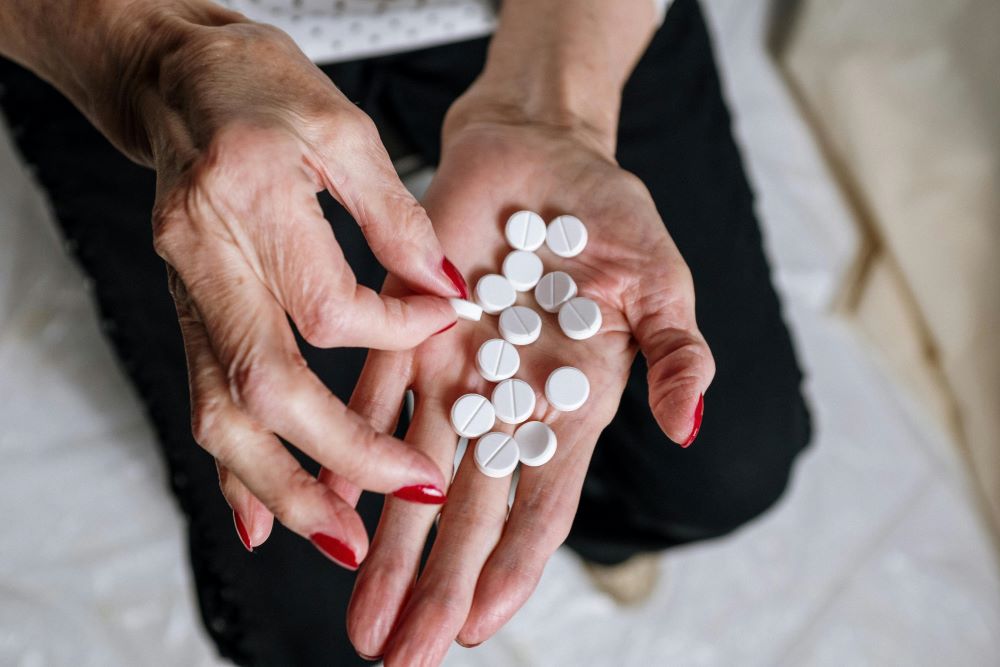
Can you safely cut pills in half?
Sometimes. Scored tablets are usually designed to be split safely, but extended-release pills, capsules, and enteric-coated medications generally should not be cut in half. When in doubt, ask a pharmacist before splitting any prescription medication.
- →Look for a score line A true score line usually means the manufacturer designed the tablet to split evenly.
- →Never split ER or XR medications Cutting extended-release pills can release too much medication at once.
- →Use a pill splitter instead of a knife Pill splitters produce more accurate and consistent doses.
Pill splitting can save real money. A 20 mg pill often costs almost the same as a 10 mg pill, so getting the higher dose and splitting halves your monthly bill. It can also be useful when a pill is too big to swallow comfortably, or when your doctor wants you on a dose that’s between two available strengths. But not all pills should be split, and getting it wrong can mean either an ineffective dose or a dangerous one.
Here’s the practical version.
The score line is the signal
A score line is the indented groove running across the middle of a tablet. Its presence isn’t cosmetic — a score line means the manufacturer engineered the tablet so the active ingredient is evenly distributed across both halves, and that splitting it produces two equal doses. No score line usually means the drug isn’t evenly mixed throughout the pill, and splitting it can produce two halves with very different amounts of active ingredient.
Some tablets have decorative grooves or shape lines that look like score lines but aren’t. If you’re not sure, ask the pharmacist. The package insert under “How Supplied” will also confirm whether the tablet is approved for splitting.
What absolutely should not be split
- Extended-release tablets — anything labeled ER, XR, SR, LA, or “controlled-release.” These have a built-in mechanism to release the medication slowly over many hours. Splitting destroys that mechanism and can dump a full day’s dose into your system at once. Common examples: metformin XR, Wellbutrin XL, Effexor XR, OxyContin, Concerta.
- Enteric-coated tablets — these have a special coating that prevents the medicine from being broken down by stomach acid, releasing it instead in the small intestine. Splitting breaks the coating, so the drug gets destroyed in the stomach (less effective) or irritates the stomach lining. Common examples: enteric-coated aspirin, some forms of omeprazole.
- Capsules — the contents may not be evenly distributed, and breaking them open spills the dose unpredictably. Some capsules are designed to be opened and sprinkled on food, but only when specifically labeled that way.
- Narrow therapeutic index drugs — medications where the gap between an effective dose and a problematic one is small. Even minor dosing inaccuracies can cause real problems. Examples include warfarin, levothyroxine, antiseizure medications (phenytoin, carbamazepine, lamotrigine), and digoxin.
- Pills you can’t see clearly or handle well — if vision, hand strength, or memory issues make precise splitting difficult, ask your pharmacist about a different strength of the same medication or a pre-split option.
Why the kitchen knife is a bad idea
A real pill splitter from the pharmacy is a few dollars and worth every cent. In studies of pill splitting accuracy, hand-splitting with a knife produces wildly variable doses — in one assessment, 60% of tablets cut by hand failed to split within 15% of the target weight. A pharmacy pill splitter has a guide that holds the pill steady and a single clean blade that produces a much cleaner cut.
Some practical tips on using one:
- Wash and dry your hands first. Moisture transfers to the pill surface.
- Place the tablet so the score line is directly under the blade.
- Press down firmly and quickly. A slow press tends to crumble the tablet.
- Some tablets just don’t split cleanly even with a proper splitter — they crumble, the coating peels, the halves are wildly different sizes. If yours behaves this way, stop and ask the pharmacist for a different solution.
Which option fits your situation?
Pill splitting may make sense
- ✓Your tablet has a real score line
- ✓You are splitting a standard immediate-release tablet
- ✓You want to lower medication costs safely
- ✓You use a proper pharmacy pill splitter
- ✓Your pharmacist confirmed the medication can be split
You should avoid splitting this medication
- ✓The medication is labeled ER, XR, SR, LA, or controlled-release
- ✓The tablet is enteric-coated
- ✓The medication is a capsule or gelcap
- ✓You take medications with narrow dosing margins like warfarin or levothyroxine
- ✓The tablet crumbles or splits unevenly even with a pill splitter
Split one at a time, not the whole bottle
Tempting as it is to split a month’s worth in one sitting, don’t. Once a pill is cut, the freshly exposed surface is open to air, light, and moisture, all of which can degrade the active ingredient over time. Splitting one pill immediately before each dose keeps the medication at full potency. Store the unused half in the original prescription bottle, not in a daily pill organizer where it sits for days.
The cost-savings angle
Here’s where pill splitting can genuinely save you money: many medications are priced almost the same regardless of the strength. A bottle of 30 tablets at 20 mg might cost roughly the same as a bottle of 30 tablets at 10 mg. If your prescription is for 10 mg daily, asking your prescriber to write the prescription for 20 mg with instructions to split can effectively halve your cost.
Common candidates where this works:
- Many statins (atorvastatin, simvastatin, pravastatin)
- Several blood pressure medications (lisinopril, losartan)
- SSRIs and other antidepressants (sertraline, citalopram, escitalopram)
- Some anti-anxiety medications (specific scored formulations)
Talk to the pharmacist before asking your prescriber for a higher dose with split instructions. They can confirm whether the specific medication and brand is suitable, whether your insurance will cover it that way, and whether the math actually works out for the products on your formulary.
And while we’re on the cost angle, the post on why the same drug costs different amounts at different pharmacies covers the broader pricing landscape. Splitting is one of several ways to cut a prescription bill.
When in doubt, ask
The pharmacist genuinely is the right person to ask before splitting any new medication — they know the formulation, can confirm the score line means what you think it means, and can spot the cases where splitting is technically possible but not ideal. The post on what to ask the pharmacist when picking up a new prescription covers the kinds of questions worth asking up front, and pill splitting fits naturally into that conversation.
For the bigger picture on managing your medications safely — storage, interactions, organizing your list — the article on medication safety across all ages is the deeper read.
Lower prescription costs with clearer pricing and smarter medication management
EasyRx connects you directly with local pharmacies for transparent cash prices on prescriptions and OTC medications — with same-day delivery. No insurance needed, no hidden fees, HIPAA compliant.